
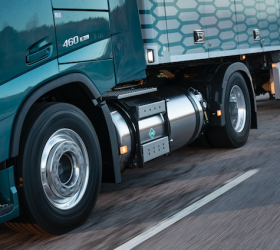
Volvo’s gas-powered trucks are growing in volume as more markets are embracing alternative fuels that enable significant reduction of CO2 emissions. 2025 was Volvo’s best sales year ever for trucks powered by gas thanks to leading products and the favourable supply and cost of fuel.
Volvo Trucks has now delivered more than 10,000 gas-powered trucks globally since the company introduced this technology in 2018. So far, UK is Volvo’s leading market, followed by Germany, Sweden, the Netherlands, Norway, and France. New upcoming gas markets include India and Latin America, where volumes are growing steadily.
Volvo’s gas engines are offered in the heavy-duty Volvo FM, FH, and FH Aero ranges, and can effortlessly run on conventional LNG (Liquified Natural Gas) or bio-LNG, a non-fossil gas derived from organic waste replacing LNG.
Volvo has now sold more than 10,000 gas-powered trucks
“Volvo’s gas engine technology is a leading solution in terms of power, torque, engine response, and fuel efficiency, and our customers also appreciate the strong performance, drivability, and overall comfort of our gas-powered trucks,” says Jan Hjelmgren, Head of Product Management at Volvo Trucks. “We see substantial potential for gas-powered trucks as an important step on the journey toward zero-emission transport.”
Volvo’s gas-powered trucks can travel up to 1,000 kilometers on a single tank, making them well suited for long-haul and regional distribution, as well as construction operations. They are a practical alternative to other low-emission solutions at a time when transport operators and freight buyers are seeking more sustainable options.
In several countries, there is already a well-developed network of gas filling stations and rapidly expanding access to bio-LNG. Some examples are Germany, Norway, Finland, and Sweden where all gas filling stations now offer the fuel. This enables many users to achieve CO2 reductions of up to 100% (Well to Wheel). In markets where tax incentives and public support for renewable fuels and low emissions are available, bio-LNG becomes a highly cost-effective alternative.
Volvo’s advanced gas engine technology is derived from its highly successful D13 powertrain, delivering diesel-like performance while substantially cutting CO2 emissions.
Volvo’s gas-powered trucks – facts:
- Volvo Trucks’ gas-powered trucks use the fuel-efficient HPDI (High Pressure Direct Injection) technology from supplier Cespira: https://cespira.com
- Volvo’s gas engine solution uses a small amount of diesel as ignition fuel, and when using HVO (Hydrogenated/ Hydrotreated Vegetable Oil) for ignition, CO₂ can be reduced up to 100% (Well to Wheel) versus a diesel-powered truck
- Biomethane is produced from organic waste liquified to bio-LNG
- Bio-LNG represents one of the fuel types for combustion engines which are a crucial part of Volvo Trucks’ powertrain strategy to reach net-zero tailpipe emissions by 2040
- Volvo Trucks’ three-path strategy to reach net-zero tailpipe emissions consists of battery-electric, fuel-cell electric, and combustion engines using renewable fuels
About the Author: admin





